Main Reason behind popularity of KTM bikes in India is its stylish look, high performance and various models offered by KTM such as 4 commuter bike in India namely KTM 125 Duke, KTM 200 Duke, KTM 390 Duke and KTM 250 Duke.
At present Bajaj Auto owns 48 percent of KTM AG, the division that deals with the manufacture and sale of KTM Motorcycles, with some motorcycles being produced in India through their association with Bajaj.
KTM bikes in India come in the price range of Rs. 1.62 Lakh to Rs. 3.28 Lakh with awesome features.
KTM RC 125 KTM bikes’ price in India starts at Rs 1.62 Lakh for KTM RC 125, which is the cheapest model. The most expensive KTM bike is 390 Adventure priced at Rs 3.28 Lakh. Most popular models for KTM includes 125 Duke (Rs 1.70 Lakh), RC 390 (Rs 2.77 Lakh), RC 200 (Rs 2.08 Lakh).
KTM 390 Duke. Rs. …
KTM RC 390. Rs.
In the world of motorcycles, KTM Orange carries the same meaning as “Ferrari Red” for motor vehicles, and when other manufacturers paint their motorcycles orange, the motorcycle world thinks only of KTM. Painting it orange is basically a branding and advertising strategy to stay unique from the rest of the brands.
Low-pressure tires are very dangerous to be left alone. While you can get a tire pressure gauge, it is not the same as monitoring the tire pressure always.
You would physically need to measure the pressure of the tire with a tire pressure gauge. But did you know that you can solve this issue by installing an automatic tire monitoring system in your car or truck?
These things are nifty, automatic and are awesome. They can be installed with great ease and come with LED/LCD displays that are by your steering which will give you an idea of the air pressure in the tires and when it is time for a refill or an adjustment.
Our list today consists of a list of the best selling and best-rated tire pressure monitoring systems or TPMS. This list has been created and curated on the basis of some key aspects which are crucial to TPMS quality. Among them all, the following are the three important aspects to it.
Sensors: The first and foremost thing to look for in such systems is the sensors. The quality of a sensor can be boiled down to the TPMS’s universality. Is the device that you picked universal in accepting all types of sensors? This is crucial because not a lot of sensors have universality and if the sensors in your car fail, the entire system fails.
Programmable Modes: The next thing to check for is the number of programmable modes you can set up the device in. General TPMS devices come with about 3 or 2 programmable modes that aid in the better monitoring of the tire air pressure in your cars. Program modes also include retuning your old sensor systems for the newly installed TPMS systems (called as the copy mode)
Accuracy: The third most important thing to consider is the accuracy of the sensors. Higher accuracy again can be determined by how easily you can reprogram new sensors in the car. The temperature of the tire can also be an indicator of this (just compare it with the gas station’s equipment once and you should be fine).
While these three are the key important factors, they are definitely not the only ones. There are a bunch of other factors which we have included in the Buying Guide section of the article. Be sure to give that a read, follow through with the Frequently Asked Questions before you make a buying decision.
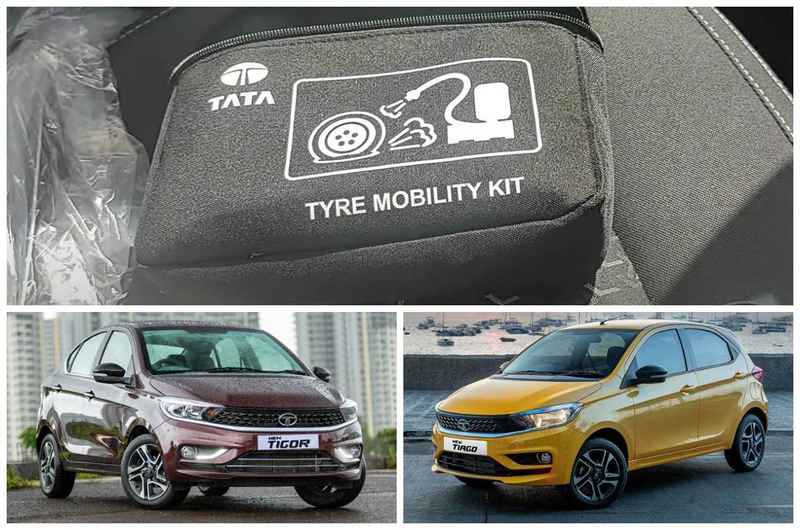
Tata has been rolling their dice and stepping up their game in terms of every automobile-related aspect with great success. They are leading in sales thanks to their budget-friendly vehicles and constant up-gradation which can be witnessed in the iterations of Tiago and Tigor.
Tata has been carefully updating their vehicles quite often to encourage people to buy their safe and reliable cars. Their latest update which came across to us as an important criterion is what Tata Motors calls, the Tyre Mobility Kit.
Let us tell you more about the Tata Tyre Mobility Kit:
The Tyre Mobility Kit has been introduced on the feature-loaded variant that is the XZ+ and XZA+ of Tiago and Tigor. These two variants will get a spare tyre, as before, and it has been confirmed that a spare tyre will be offered in the future variants too.
The Tyre Mobility Kit on the Tata Tiago and Tigor can be found placed below the driver’s seat. The kit consists of a tyre pressure monitor that can be charged with the vehicle’s USB slot and a sealed liquid pack that is used to repair a tyre puncture.
Tata dealers have stated that the Tata Tyre Mobility kit will be only available on the top-spec variants based on the demand. Also, it will be equipped across other ranges of vehicles too in the future.
The Tiago and Tigor, budget hatchback and compact sedan respectively, have been equipped with a 1.2-liter three-cylinder which churns out 86hp. Although they have 86hp, they are not the best in terms of refinement, however, considering the fact these vehicles are budget-friendly, it can be ruled out easily. The two vehicles come with a 5-speed manual transmission and an AMT gearbox which is another option to opt for. Till now, 27,245 units of the Tiago and 7,688 units of the Tigor have been sold since the beginning of 2021.
Delhi Traffic Police has focused on ‘uniformity’ while revising the maximum speed limits of vehicles in the National Capital. Here we tell you all about the maximum speeds for all categories of vehicles and how the speed limits vary on different roads.
Image source: The Indian Express, Express Archives
Delhi Traffic Police has revised the maximum speed limit for vehicles in the National Capital. Needless to say, this has been done in order to ensure the safety of motorists and everyone else on the roads. In order to be precise, for vehicles that fall under the M1 category like cars, jeeps and taxis, the speed limit has been fixed at 60 to 70 kmph on high speed/access controlled roads, including stretches of the national highways passing through Delhi, Noida Toll Road, Saleemgarh bypass road, Northern Access Road, Central Spine Road, Barapullah Nallah, Ring Road, Outer Ring Road, Pusta Road and IGI Airport road. Passenger vehicles with not more than eight seats in addition to driver’s seat like cars, Jeeps and cabs come under the M1 category of vehicles.
On arterial roads, the maximum speed limit of these vehicles is different. In order to be precise, on all other arterial roads in the areas between Ring Road and Outer Ring Road, beyond Outer Ring Road, inside Ring Road and the entire Trans Yamuna area, the speed limit for these vehicles is set at 50 Kmph. Also, in order to bring uniformity, the maximum speed limit for taxis and cabs is now at par with private cars on these roads, officials say. Now, speaking of two-wheelers, the speed limit has now been reduced from 70 kmph to 60 kmph on roads where the speed of cars is set at 60 to 70 kmph. Moreover, it remains at 50 kmph on roads where the speed of cars is 50 kmph and hence, this has been again done to bring uniformity at par with other categories of vehicles, officials said. That said, the speed limit for two-wheelers is now 50 to 60 kmph in the National Capital.
Having said that, on national highways, where cars can touch a maximum of 70 kmph, two-wheelers can’t cross 60 kmph. Similarly, the speed limit for light motor vehicles (eg – vans and tempos) has been revised to 50 to 60 kmph on highways as well as other roads. These vehicles come under the M2 and M3 category that basically comprises passenger vehicles comprising nine or more seats in addition to the driver’s seat. In order to be precise, these vehicles can now ply at speeds of 50 kmph on roads where the speed of cars is 50 kmph. On the other hand, these can do 60 Kmph on roads where the speed of cars is limited at 60 to 70 kmph.
The traffic police has also set up the speed limit for vehicles like Gramin Sewa, TSRs, Phat-Phat Sewa and Quadricycle and all types of transport vehicles (excluding M1, M2, M3 categories) at 40 kmph across Delhi. In addition, the traffic police has also set the maximum speed limit on residential areas, markets, service lanes and for minor roads inside all residential areas, commercial markets and service roads. On such roads, one cannot cross a speed of 30 kmph. The speed limit for transport vehicles in these areas earlier was 20-30 kmph and the same has now been revised to create uniformity as per the officials. Moreover, the maximum speed limit for the loops of flyovers has now been fixed at 40 kmph.
With vehicle safety increasing in the last few years, the revision of the maximum speed limit was certainly required. As one can see, the traffic police has increased the maximum speed limits in some cases and this will translate into fuel-saving, not just for users but for Govt as well. Moreover, the focus of the traffic police this time is to bring uniformity in the maximum speed limits of different vehicles. With this, as vehicles will be running at similar speeds, the chances of an accident shall get reduced.
For more information on tyres and Services Please Call: 8699520216 (Mobile and Whatsapp)
About Us
Vishvas Tyres, a well-established multi-brand tyre showroom in Bathinda, proudly serving customers since 2013. We offer high-quality tyres &services at competitive prices for all types of vehicles.